




What TPU Hardness Is Best for Phone Case Protection?
For most protective phone cases, TPU in the Shore A 85-95 range is the most practical choice. It offers a useful balance of impact absorption, shape retention, grip, and resistance to everyday scuffing. Within that range, roughly Shore A 90-95 is often the stronger starting point for a slim but protective case, while Shore A 85-90 can work well when a softer feel and easier installation matter more.
That answer needs context. TPU hardness is only one part of phone case protection, and selecting the hardest material does not automatically produce the safest case. A case needs to deform enough during a drop to spread impact energy, but it must also stay firm enough to hold its shape, protect corners, and remain securely fitted after repeated use. The best TPU hardness for phone case protection depends on the case geometry, wall thickness, phone size, surface finish, and the level of drop protection expected.
What TPU hardness actually means
TPU, or thermoplastic polyurethane, is commonly used in phone cases because it combines rubber-like flexibility with the processability of a thermoplastic. It can be injection molded, colored, textured, overmolded, or combined with harder materials such as polycarbonate.
Phone-case TPU is usually described with the Shore A hardness scale. A lower Shore A number indicates a softer, more flexible material. A higher number indicates a firmer material with greater resistance to indentation and deformation. Hardness does not directly measure drop protection, tensile strength, scratch resistance, or yellowing resistance. It is one useful indicator, not a complete material specification.
A very soft TPU may feel cushioned and grippy, but it can stretch around button openings, attract lint, deform at thin sections, and lose its precise fit over time. A very hard TPU can create a slim, structured case, but it may transmit more impact force if the design does not include adequate corner volume or flexible shock-absorbing zones.
The practical TPU hardness ranges for phone cases
For a conventional single-material TPU case, 85A-95A is usually the useful design window. It supports a clean fit, provides reasonable resilience, and remains flexible enough to wrap around the phone without behaving like a rigid shell.
Cases positioned as thin, clear, or everyday protective products often benefit from the upper part of that range because the material must maintain edge definition and avoid a loose fit. Cases designed for a more tactile, shock-absorbing feel may use a slightly softer TPU, especially in thicker bumper areas.
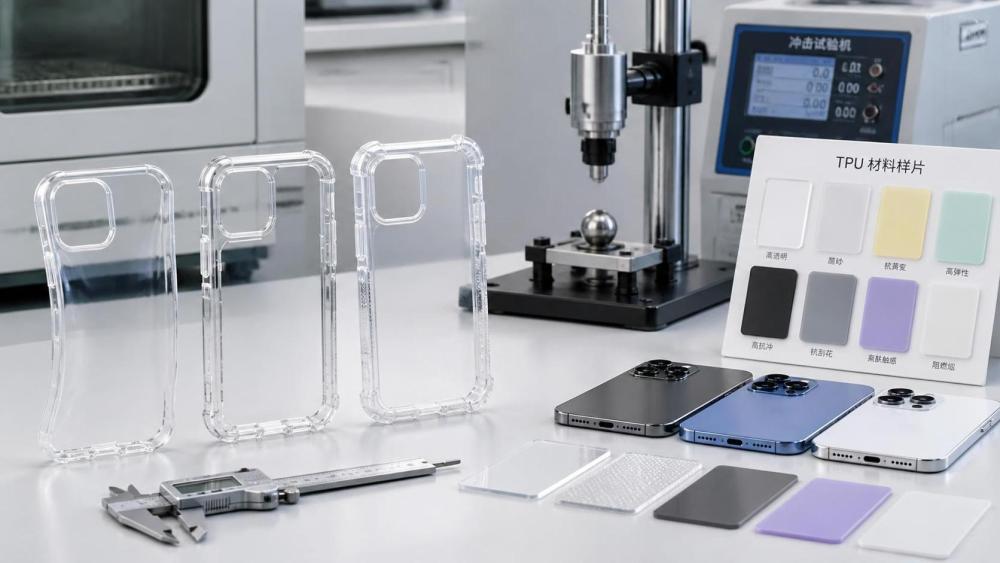
Why 90A-95A is often the best starting point
A TPU around Shore A 90-95 generally gives designers enough stiffness to create a case that stays close to the device. This matters because a loose case can allow movement during impact, reducing the value of the protective structure around the edges and camera area.
At this hardness, TPU can still flex during installation and during a drop. The material does not need to be extremely soft to absorb energy. In a well-designed case, protection comes from controlled deformation across the sidewalls, raised edge geometry, corner reinforcement, and sufficient material thickness where impact is likely. Firmer TPU helps those features retain their intended form.
This range also tends to work well for functional details that consumers notice immediately: button covers that remain responsive, ports that do not distort, corners that do not sag, and a perimeter that stays aligned with the phone after repeated removal. These are not merely appearance concerns. A poorly fitting edge can expose the device when it lands at an angle.
Still, 90A-95A should not be treated as a universal formula. A thin case using firm TPU may provide less real-world drop protection than a thicker case using a slightly softer grade with well-engineered corners. The hardness should support the design, not replace it.
Hardness alone does not determine impact protection
When comparing TPU grades, it is easy to focus on the Shore A number because it is simple to read on a datasheet. However, phone cases experience short, high-strain impacts rather than slow compression. The material’s ability to recover after deformation, resist tearing, and remain stable through temperature changes can matter just as much as nominal hardness.
A TPU formulation may be 90A yet behave differently from another 90A material due to its polymer structure, additives, pigment system, moisture condition during molding, or processing history. Some grades are optimized for abrasion resistance; others for clarity, soft touch, weathering, or bonding to a rigid substrate. Two cases with the same stated hardness can therefore have noticeably different grip, resilience, surface feel, and long-term fit.
Wall thickness changes the result further. A 90A TPU case with thin, flat sidewalls may feel flexible. The same grade in a thicker corner bumper will feel much firmer and can create a more controlled crush zone during impact. This is why material selection should always be reviewed alongside the CAD design rather than as an isolated resin decision.
Choose the hardness around the case design
Thin, minimalist TPU cases
A slim case needs enough firmness to avoid stretching and waviness, particularly around the camera opening and side buttons. Shore A 90-95 is usually more suitable than very soft TPU for this format. The limited thickness means the case cannot rely on bulk for protection, so a secure fit and accurately formed raised edges become more important.
Minimalist cases should not make broad drop-protection claims simply because they use TPU. Their main value is scratch protection, improved grip, and modest impact buffering. For users who routinely drop their phone onto hard surfaces, a thin single-layer design has clear physical limits regardless of hardness.
Soft-touch and grip-focused cases
A softer grade around 85A-90A can create a more comfortable grip and a less rigid feel at the edges. It is useful where the case has enough thickness to prevent excessive stretching and where the design includes substantial corner coverage. This approach can also make installation easier, which matters for cases with tight device tolerances.
The risk is long-term dimensional change. Soft TPU needs careful attention around large cutouts, thin bridges near buttons, and unsupported camera sections. A material that feels premium when new can look loose after repeated flexing if the design does not account for creep and recovery.
Hybrid cases with a rigid back
Many protective cases combine a TPU bumper with a harder polycarbonate back panel. In this construction, TPU does not need to provide all structural stiffness. A TPU in the 85A-95A range can supply edge cushioning and grip while the rigid panel supports the overall shape.
The material interface becomes important. Mechanical interlocks, overmolding compatibility, surface preparation, and thermal behavior all influence whether the two materials remain securely joined. A visually appealing hybrid case can fail early if the bumper separates from the back panel, especially around corners where flexing is concentrated.
Heavy-duty protective cases
For thicker, rugged cases, hardness should be selected as part of a system. A somewhat softer TPU layer may be beneficial in an internal impact-absorbing section, while a firmer outer frame protects against abrasion and maintains structure. This can be achieved through multi-material construction or through geometry that creates different stiffness zones from the same material.
Using only very hard TPU in a heavy-duty case can produce a robust feel without delivering the desired impact management. Conversely, making every section soft can create an oversized case with poor dimensional control. Corner design, air gaps, rib placement, and raised screen and camera protection often matter more than pushing hardness in either direction.
Clear TPU requires a different conversation
Clear phone cases create an additional challenge because users judge them heavily by optical appearance over time. TPU hardness can influence surface durability and shape retention, but it does not by itself prevent discoloration. Yellowing and haze are affected by the polymer chemistry, stabilizer package, exposure to light and heat, contact with oils and cosmetics, and the quality of processing.
A clear case should therefore be specified for more than hardness. Consider transparency, haze, UV stability, resistance to staining, and the appearance of flow lines or gate marks after molding. A firm transparent TPU may still discolor, while a softer grade with appropriate stabilization may retain a better appearance in its intended use conditions.
For clear cases with very rigid-looking back panels, a hybrid approach is often more practical: a hard clear back can preserve visual flatness, while TPU is used selectively around edges and corners. The material choice should match the visual promise of the product, not just its initial clarity.
Common selection mistakes
- Choosing the highest hardness for “maximum protection.” Excessive firmness may reduce useful deformation during impact and make a case difficult to install or remove.
- Using Shore hardness as the only specification. Recovery, tear resistance, abrasion resistance, color stability, and molding behavior should also be reviewed.
- Ignoring wall thickness. A small thickness change can alter perceived stiffness and impact behavior more than a modest hardness difference.
- Testing only a fresh sample. A case should remain fitted after repeated flexing, heat exposure, pocket use, and contact with normal consumer contaminants.
- Copying a hardness from a competitor case. The same number may not transfer to a different mold, geometry, pigment, or processing setup.
A useful material brief before requesting TPU samples
Rather than asking a supplier only for “90A TPU,” define the case and its requirements. Start with whether the product is a slim shell, full-wrap bumper, clear case, hybrid construction, or rugged design. Then identify the important use conditions: expected handling, desired surface feel, repeated removal frequency, exposure to sunlight or heat, and whether visual clarity is central to the product.
Next, review the areas most likely to fail. For a phone case, these usually include corners, thin button bridges, camera openings, port cutouts, and interfaces between soft and rigid materials. The preferred hardness may differ if the case has very thin sidewalls, large unsupported openings, or a design that depends on a tight press fit.
Material teams also need to consider manufacturing behavior. TPU is sensitive to moisture, and inadequate drying can affect surface appearance and mechanical consistency. Mold temperature, gate placement, cooling, and material flow influence final dimensions and cosmetic quality. A suitable grade in a poorly controlled process can still produce a case with warped edges, visible flow marks, or inconsistent fit.
Resources such as APIM’s materials coverage are most useful at this stage because material selection becomes a comparison of formulation, processing, durability, and application geometry rather than a search for one hardness number. That is the level at which a phone case specification becomes repeatable across production runs.
FAQ
Is 95A TPU better than 85A TPU for a phone case?
Not automatically. A 95A grade is firmer and can hold a slim case shape well, while 85A may provide a softer grip and more visible flexibility. The better choice depends on thickness, corner design, and whether the case needs structural support or a softer cushioning feel.
What Shore hardness is used for soft phone cases?
Soft cases commonly fall in the lower portion of the practical phone-case range, often around 80A-90A. Below that range, the material may become too flexible for thin, close-fitting designs unless the geometry provides additional support.
Does harder TPU scratch less easily?
Harder TPU can resist indentation and surface damage better in some applications, but scratch resistance also depends on the formulation, surface texture, additives, and contact conditions. Hardness alone cannot predict how clean a case will look after daily use.
Should a protective TPU case be thick or hard?
Protection comes from the combination of material behavior and design. Extra thickness in the corners, raised protective lips, and a secure fit often contribute more than simply selecting a harder TPU. A moderately firm TPU with thoughtful geometry is generally more useful than an extremely hard material in a thin, flat design.
For an everyday case, starting around Shore A 90-95 is a sensible material direction, then adjusting for wall thickness, corner structure, desired grip, and long-term appearance. The final selection should be validated in the actual molded case, because the phone case design determines how the TPU performs when it matters.
Have questions about this sector analysis, or seeking best practices specific to your niche? Drop us a line below and let the senior consultants at APIM assist you.
We respect your privacy. Your information is strictly confidential.
Related News
- 00
0000-00
Do polyolefin hot melt adhesives bond well to polyethylene? - 00
0000-00
Korean Study Finds PLA Barely Degrades in Landfill After 320 Days - 00
0000-00
How to assess batch consistency from a thermal potting compounds supplier - 00
0000-00
How much weight can carbon fiber reinforced plastics save in cars? - 00
0000-00
Switching from PS to ABS Sheet Extrusion: Equipment Checks