




What Fatigue Tests Must Aerospace Structural Adhesives Pass?
What Fatigue Tests Must Aerospace Structural Adhesives Pass?
Aerospace structural adhesives are rarely judged by a single lap-shear result. A bonded joint may show high initial strength in a laboratory pull test and still lose integrity after years of cyclic loading, vibration, thermal movement, moisture exposure, or contact with aircraft fluids. The practical question is therefore not simply whether an adhesive is strong, but whether the complete bonded assembly retains a predictable safety margin throughout its intended service life.
For teams asking what fatigue tests should structural adhesives pass for aerospace use, the short answer is that there is no universal pass/fail sequence for every aircraft application. Required testing depends on the joint design, adherend materials, load path, operating temperatures, manufacturing route, damage tolerance philosophy, and the qualification requirements set by the aircraft manufacturer or program authority. Still, several test families form the core of a credible aerospace adhesive fatigue evaluation.
This distinction matters especially for bonded aluminum, titanium, and carbon-fiber composite structures, where the adhesive, surface treatment, primer, cure process, and local geometry operate as one system. A material data sheet is useful for screening, but it is not a substitute for joint-level fatigue evidence.
Why Static Strength Does Not Predict Fatigue Life
Static tests measure the force needed to break a specimen once. Fatigue testing asks a harder question: what happens when the same bond experiences a changing force thousands or millions of times? In flight, loads can be generated by cabin pressurization cycles, maneuver loads, landing events, engine and aerodynamic vibration, thermal expansion mismatch, and repeated opening or closing of access structures.
The most damaging condition is not always the highest individual load. A joint can accumulate damage at relatively modest stress levels if peel stresses are present, if load transfer is uneven, or if moisture and elevated temperature reduce the interface’s resistance to crack growth. Adhesive fatigue failures often begin at an edge, a void, a bondline thickness variation, a poorly prepared surface, or a local geometry change that concentrates stress.
For this reason, aerospace programs usually evaluate fatigue as part of a broader durability framework. The objective is to understand crack initiation, crack propagation, residual strength after cycling, and the way environmental aging changes each of those behaviors. A high-strength epoxy film adhesive, for example, may be appropriate for one stiff metal joint but less suitable for a flexible, peel-dominated configuration unless the overall design and toughening strategy support it.
The Core Fatigue Tests for Bonded Aerospace Joints
A sensible test plan normally progresses from controlled coupon testing to representative subcomponents. Early tests provide comparable material and process data; later tests reveal the effect of actual geometry, fasteners, load introduction, environmental sealing, and manufacturing variation.
Cyclic lap-shear fatigue testing
Cyclic lap-shear testing is a common starting point because many bonded joints carry a substantial shear component. The specimen is repeatedly loaded in tension so that shear is transferred through the adhesive overlap. ASTM D3166 is widely recognized as a test method addressing fatigue properties of adhesives in shear by tension loading for metal-to-metal joints. It can help compare adhesive systems, surface preparations, primers, cure conditions, and environmental exposures under controlled conditions.
Results should not be read as a direct prediction of aircraft life. A single-lap specimen has bending effects that may introduce peel stresses, while real structures may have different stiffness, overlap length, bondline thickness, and load spectra. Even so, tests at multiple stress levels can establish an S–N relationship—applied stress versus cycles to failure—and identify whether a proposed system has a usable fatigue margin.
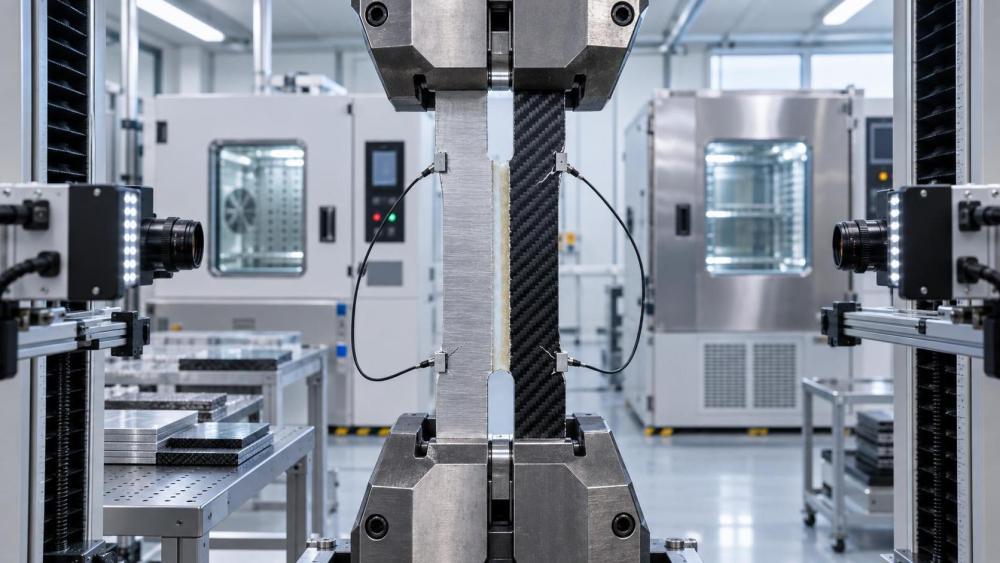
Crack-growth and fracture-mechanics testing
For critical bonded structures, resistance to crack propagation can be more informative than cycles to complete failure. These tests use pre-cracked specimens and monitor the rate at which a crack advances under cyclic opening, shear, or mixed-mode loading. Mode I loading is primarily opening or peel; Mode II is sliding shear; many aircraft joints experience a combination of both.
This approach supports damage-tolerance decisions because it distinguishes between an adhesive that survives until a sudden failure and one that resists the stable growth of a detectable defect. It also helps engineers assess whether small process defects, impact damage, or edge flaws could become critical over time. Test configuration and data reduction methods need to match the relevant substrate and loading mode, particularly for composite-to-composite and composite-to-metal bonds.
Peel, cleavage, and mixed-mode fatigue
A joint that looks shear-dominated in a drawing may develop peel at its ends because of eccentric loading, adherend bending, thermal mismatch, or assembly tolerances. Peel and cleavage fatigue tests are therefore important where thin skins, stiffeners, sandwich panels, bonded doublers, or composite laminates are involved. These conditions are often less forgiving than pure shear because the adhesive layer is being pulled open rather than loaded uniformly across the overlap.
Mixed-mode testing becomes particularly valuable when the joint contains curved surfaces, stepped adherends, tapered laminates, or nonuniform stiffness. The purpose is not to create an unrealistic “worst possible” test, but to reproduce the failure mechanism most likely to govern the actual design.
Spectrum loading and variable-amplitude fatigue
Constant-amplitude cycling is efficient for ranking materials, yet aircraft loads are variable. A representative fatigue program may therefore include spectrum loading, in which load magnitude, sequence, and frequency change in a defined pattern. Occasional high-load events can alter crack-growth behavior, while low-level vibration may produce large numbers of cycles that are not captured by a simple constant-amplitude test.
The spectrum should come from structural analysis and program-specific requirements rather than from a generic laboratory recipe. Load ratio also matters. A joint cycled between tensile loads may behave differently from one that sees tension-compression cycling, especially where adhesive compression, adherend buckling, or local peel is possible.
Fatigue Must Be Tested in the Real Environmental Envelope
Environmental conditioning is not an optional add-on to aerospace adhesive fatigue testing. Adhesives can absorb moisture, soften near elevated temperatures, become less compliant at low temperatures, or experience interfacial degradation after exposure to fluids. The question is not whether the cured adhesive remains intact in a benign laboratory environment; it is whether the bonded system retains sufficient performance after realistic conditioning.
Temperature and moisture are especially consequential for mixed-material assemblies. Carbon-fiber composites, aluminum alloys, titanium, and thermoset adhesives do not expand or transfer heat in the same way. A joint can therefore undergo internal stress changes even when no external mechanical load is present. Thermal cycling followed by mechanical fatigue is often more revealing than either exposure alone.
Durability Tests That Support, but Do Not Replace, Fatigue Testing
Several tests are frequently included in aerospace bonding qualification because they expose weaknesses in surface preparation or environmental durability. They should be viewed as complementary evidence rather than interchangeable alternatives to cyclic fatigue tests.
Static lap-shear testing, including methods such as ASTM D1002 for metal-to-metal adhesive bonds, establishes an initial reference point. ASTM D5868 is commonly used for lap-shear testing of fiber-reinforced plastic bonding. These tests can reveal whether a process produces consistent bond strength, but they do not establish long-term fatigue resistance on their own.
Wedge-based durability testing can be valuable for assessing susceptibility to environmental attack at a bonded interface. ASTM D3762 is one recognized wedge-test method for adhesive-bonded aluminum surface durability. Such evaluations are useful when qualifying pretreatments and primers, since a fatigue-resistant adhesive cannot compensate indefinitely for a surface that loses adhesion after moisture ingress.
Vibration testing also has a place where equipment mounts, interior structures, electronic assemblies, or local bonded brackets encounter resonant conditions. However, vibration should be specified in relation to the actual assembly and service environment. It is not enough to state that an adhesive is “vibration resistant” without defining frequency range, acceleration, fixture stiffness, applied preload, and acceptance criteria.
What a Meaningful Pass Criterion Looks Like
A credible pass criterion is tied to a design requirement, not a marketing claim. It may require survival to a defined number of cycles at a specified load spectrum; a maximum permitted crack-growth rate; retention of residual static strength after fatigue and environmental exposure; or an acceptable failure mode. The applicable aircraft program may also define specimen counts, minimum test temperatures, manufacturing controls, and statistical treatment of results.
Failure mode deserves attention. Cohesive failure within the adhesive can indicate one type of load response, while adhesive failure at the interface can point toward surface-preparation, contamination, primer, or environmental-durability concerns. Neither observation should be interpreted in isolation. Fracture-surface examination, bondline measurements, cure verification, and records of substrate pretreatment are often needed to determine the real cause.
For procurement teams, a supplier statement that an adhesive is “aerospace grade” should trigger more questions, not end the discussion. Ask which adherends were tested, which surface preparation was used, whether data are conditioned or dry, what joint geometry was evaluated, and whether the test sequence reflects the intended application. Approval for one airframe program or one bondline process does not automatically transfer to another.
Common Gaps in Adhesive Fatigue Evaluation
- Using dry, room-temperature static strength as the main selection criterion.
- Testing a convenient coupon geometry that does not represent peel, bending, or mixed-mode loading in the structure.
- Qualifying the adhesive chemistry without qualifying surface preparation, primer application, cure cycle, and bondline control.
- Ignoring edge sealing and fluid ingress pathways in joints expected to see moisture or chemical exposure.
- Treating fatigue life as a single number rather than reviewing scatter, load level, environment, and failure mechanism.
The last point is easy to overlook. Adhesively bonded structures are sensitive to process variation because the interface is created during manufacturing. Storage conditions, out-time, substrate handling, contamination control, cure temperature, pressure, and void content can all influence the fatigue result. Material selection and process qualification should therefore proceed together.
Building a Better Decision Path
The most effective evaluation starts with the structural question: what loads will the bond carry, in what direction, for how long, and under which environmental conditions? That leads to a test matrix rather than a generic test request. Early screening can compare several adhesive and surface-treatment combinations. More advanced work should then focus on representative geometries, environmental conditioning, cyclic crack growth, and residual strength.
This is also where structured material intelligence is useful. Global Advanced Polymers & Industrial Materials Intelligence Network (APIM) examines industrial adhesives in the broader context of polymer formulation, composite bonding, processing control, chemical compatibility, and long-term service conditions. For technical and purchasing teams, the practical value lies in connecting adhesive data to the manufacturing variables that can change real joint reliability.
Before selecting an aerospace structural adhesive, confirm the governing program specification, intended substrates, required surface preparation, expected service temperatures, fluid exposures, inspection approach, and fatigue acceptance criteria. The adhesive must pass the right fatigue tests for the actual joint—not merely perform well in the easiest test available.
Have questions about this sector analysis, or seeking best practices specific to your niche? Drop us a line below and let the senior consultants at APIM assist you.
We respect your privacy. Your information is strictly confidential.
Related News
- 00
0000-00
How does washing affect contamination in post-consumer recycled PP resins? - 00
0000-00
How does feedstock affect depolymerization equipment selection? - 00
0000-00
US Sets 213.44% Preliminary Antidumping Deposit on Chinese PTMEG - 00
0000-00
When should epoxy be used as a thermal interface material for semiconductors? - 00
0000-00
US Midterm Results Unlikely to Quickly Shift Recycled Plastics Market or Legislation