




TPU Material Failures: Common Causes and Practical Fixes
Why TPU Failures Need Context Before Fixes
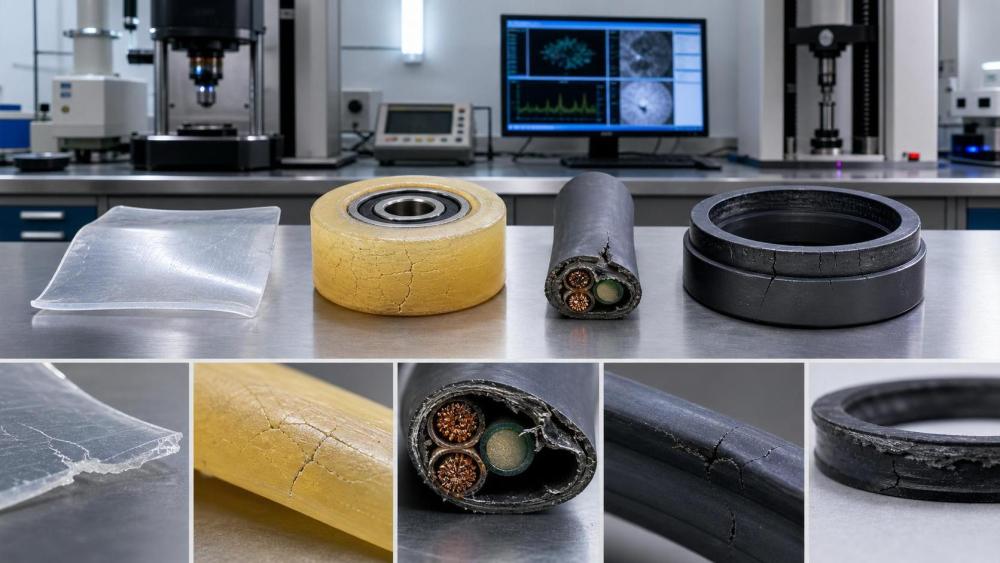
TPU is often selected for flexibility, abrasion resistance, and long service life.
Yet field complaints still appear in seals, cable jackets, wheels, films, tubing, and overmolded parts.
The reason is simple.
A TPU failure rarely comes from one factor alone.
Material grade, processing history, load profile, chemical exposure, and part geometry often interact.
In practical troubleshooting, the same crack can mean hydrolysis in one application and stress concentration in another.
That is why TPU failure analysis should begin with use conditions, not only with datasheet values.
Across modern manufacturing, APIM frequently frames polymer decisions this way.
Performance only becomes meaningful when linked to heat, pressure, chemicals, motion, and production stability.
For TPU, that structured view helps shorten root cause analysis and reduce repeat failures.
Different TPU Applications Fail for Different Reasons
Not every TPU application asks for the same balance of hardness, elasticity, chemical resistance, and processability.
A cable sheath may need flex life and flame performance.
A wheel tread may care more about abrasion and heat buildup.
A transparent film may fail first through blocking, haze, or surface tack.
This is where many TPU decisions go wrong.
A grade that performs well in static sealing may fail quickly in cyclic bending.
A formulation suited to indoor electronics may degrade outdoors under UV and humidity.
More reliable evaluation usually starts with four checks.
- What kind of stress dominates: tensile, compressive, bending, impact, or repeated friction.
- Whether the TPU sees oils, cleaners, moisture, UV, or elevated temperature.
- How the part is processed: extrusion, injection molding, overmolding, film casting, or compounding.
- Whether failure appears immediately, after installation, or only after long service.
Those answers narrow the fault path much faster than replacing material by hardness alone.
When Cracking and Splitting Show Up in Dynamic Parts
Cracking is one of the most common TPU failure signals in industrial use.
It appears in rollers, belts, seals, protective covers, and flexible connectors.
In dynamic applications, the first question is whether the crack starts from the surface or the core.
Surface cracking often points to UV exposure, ozone, chemical attack, or excessive dryness after processing.
Core splitting more often suggests poor melt quality, internal stress, or weak knit lines.
Polyester-based TPU may also lose toughness in hot and wet conditions because of hydrolysis.
That matters in tubing, outdoor parts, and warm-water contact components.
Practical fixes depend on the actual service profile.
- Use polyether TPU when moisture resistance matters more than oil resistance.
- Reduce notch effects by increasing radii and smoothing gate transition zones.
- Dry TPU correctly before molding to avoid molecular damage and unstable flow.
- Lower excessive residence time and melt temperature during processing.
- Add UV stabilization when outdoor aging is part of the real use case.
A frequent misjudgment is treating all cracks as a resin weakness.
In many molded TPU parts, geometry and process stress are equally responsible.
Abrasion, Deformation, and Heat Buildup in Contact Surfaces
TPU is widely chosen for wear parts, but abrasion performance is highly condition-dependent.
A conveyor guide, caster wheel, and scraper blade do not wear in the same way.
Sliding wear is different from rolling wear.
Intermittent contact is different from continuous pressure with heat buildup.
In these cases, premature TPU failure may show as flat spots, softening, edge tearing, or dusting.
The visible wear pattern helps separate mechanical overload from thermal damage.
If the part softens and smears, frictional heat is likely a bigger issue than basic abrasion.
If edges chip or tear, hardness may be too high for impact conditions, or support design may be uneven.
This is why APIM often links polymer performance to the process and machine environment around it.
Wear data without contact conditions gives only partial guidance.
Surface Problems in Films, Cables, and Consumer-Facing Parts
Some TPU failures are less dramatic but equally costly.
Blocking, blooming, tackiness, haze, color shift, and printability loss often trigger rejection first.
These issues are common in specialty films, wire and cable, coated fabrics, and overmolded housings.
In actual production, surface defects are often blamed on the TPU grade too early.
The better check is whether additives, migration behavior, cooling rate, and storage conditions were aligned.
A soft TPU film stacked before full cooling may block even if the base resin is appropriate.
A cable jacket exposed to incompatible cleaners may turn sticky despite stable mechanical properties.
For transparent TPU parts, haze may come from moisture, contamination, or poor melt filtration.
Useful corrections usually include tighter drying control, better screen changes, controlled winding temperature, and compatibility review for inks or surface treatments.
Processing Problems That Later Look Like Material Failure
Many TPU complaints begin in extrusion or molding, but only become visible after shipment.
Bubbles, brittleness, inconsistent hardness, weak bonding, and dimensional drift can all start with process control.
This matters especially when compounding, regrind use, or multi-layer structures are involved.
TPU is sensitive to moisture.
Poor drying can reduce molecular weight and leave parts weaker than expected.
Excessive shear can also damage the polymer and create unstable viscosity.
In extrusion lines, feeding fluctuation, long residence time, and insufficient degassing often show up later as gels, odor, or weak spots.
A practical troubleshooting sequence is often more effective than repeated grade changes.
- Confirm drying temperature, time, and actual moisture level.
- Review melt temperature against supplier guidance and real residence time.
- Check screw design, back pressure, and filtration condition.
- Compare failed lots with stable lots for regrind ratio and line settings.
- Validate part performance after conditioning, not only immediately after molding.
For industrial material decisions, this process-first discipline often prevents unnecessary specification changes.
Where Misdiagnosis Happens Most Often
The most common TPU mistake is assuming similar applications have identical service demands.
Two seals may look alike while one sees grease and the other hot water.
Two films may share thickness while one faces outdoor UV and the other stays indoors.
Another frequent mistake is reading TPU hardness as a full performance shortcut.
Hardness matters, but it cannot replace checks on hydrolysis resistance, compression set, rebound, tear strength, or chemical compatibility.
Cost-focused substitution can also create hidden maintenance expense.
A lower-priced TPU may process well at first, then fail through aging, migration, or unstable batch behavior.
The better approach is to compare total service performance over the actual duty cycle.
Practical TPU Checks Before the Next Production Run
A useful next step is to organize TPU troubleshooting around the real application path.
Start with the failed location, then map stress, environment, processing history, and time to failure.
That usually reveals whether the TPU issue is design-related, process-related, or formulation-related.
For repeat programs, build a short comparison sheet covering moisture exposure, peak temperature, chemical contact, motion type, and expected life.
Then align material data, line settings, and part geometry against those conditions.
This is also where APIM-style structured material review becomes useful.
When TPU decisions are tied to processing methods, application trends, and long-term operating conditions, troubleshooting becomes more precise.
The immediate goal is not only to replace a failed part.
It is to define clearer selection rules, tighter process controls, and better field feedback for the next run.
Have questions about this sector analysis, or seeking best practices specific to your niche? Drop us a line below and let the senior consultants at APIM assist you.
We respect your privacy. Your information is strictly confidential.
Related News
- 00
0000-00
How does washing affect contamination in post-consumer recycled PP resins? - 00
0000-00
How does feedstock affect depolymerization equipment selection? - 00
0000-00
US Sets 213.44% Preliminary Antidumping Deposit on Chinese PTMEG - 00
0000-00
When should epoxy be used as a thermal interface material for semiconductors? - 00
0000-00
US Midterm Results Unlikely to Quickly Shift Recycled Plastics Market or Legislation