




Setting PUR Panel Lamination Parameters: Heat, Pressure, and Line Speed
A sound PUR bond on MDF depends on more than the temperature shown on the adhesive unit. The adhesive must reach the bonding interface in a suitable condition, the film must contact the board before the adhesive loses its useful open time, and the nip must establish contact without damaging either surface. Heat, pressure, and line speed therefore need to be set as a connected process—not as three independent adjustments.
There is no universal recipe for every MDF grade, decorative film, and reactive polyurethane hot-melt adhesive. Begin with the adhesive supplier’s technical data sheet, the film supplier’s processing limits, and the machine’s operating instructions. Establish a production window through controlled trials, then record both machine settings and actual material conditions.
Confirm MDF and film compatibility before adjusting the line
Reactive PUR hot melts develop initial handling strength as they cool, followed by moisture-driven chemical curing. Initial tack is therefore not proof of a fully developed bond. Adhesive selection, surface wetting, and subsequent curing conditions all matter. These principles are described in Pocius’s Adhesion and Adhesives Technology and the Forest Products Laboratory’s Wood Handbook. [1, 2]
For MDF, check the surface actually being laminated. A sanded board face, a sealed face, and a machined profile present different bonding conditions. Loose sanding dust can become the weak layer between adhesive and board. Surface irregularities can also produce uneven contact or visible defects beneath thin decorative films. Wood-based substrates exchange moisture with their surroundings, so storage and conditioning belong in the bonding process, not just warehouse management. [2]
Record the board grade, thickness, surface preparation, storage conditions, and moisture condition using a suitable measurement method. Do not transfer a moisture limit from an unrelated adhesive or board specification. Cold boards brought into a warm production area should be conditioned sufficiently to avoid condensation and unstable processing conditions.
“Decorative film” is not a sufficient material specification. PVC, PET, polypropylene, and paper-based coverings can have different bonding surfaces and thermal limits. The reverse side may require a primer or surface treatment, and a visually similar replacement film may have a different backing formulation. Confirm compatibility for the exact film construction and adhesive grade rather than relying on the polymer name alone. Surface chemistry and preparation strongly influence adhesion. [1]
A useful incoming-material check identifies:
- The film’s bonding side, backing treatment, and supplier-approved adhesive families.
- Its allowable processing temperature and sensitivity to tension or roller marking.
- The MDF face preparation and any sealer, coating, or contamination.
- The adhesive’s application method, processing window, and stated curing conditions.
Control the heat reaching the bond line
The melter display is a control setting, not a direct measurement of adhesive temperature at the board. The melter, hose, applicator, coating roller, and substrate can each affect the thermal condition at application. Compare actual readings with setpoints using appropriate, maintained instruments and the machine manufacturer’s measurement procedure.
Insufficient heat can leave the adhesive too viscous for consistent application and wetting. Excessive heat can exceed the adhesive’s processing limits or the film’s thermal tolerance. Raising temperature to compensate for poor contact may therefore exchange one defect for another. The relationship between temperature, viscosity, wetting, and adhesive stability is discussed in adhesive technology references; the permissible limits must come from the selected product’s technical data sheet. [1]
Observe where the problem occurs. Poor transfer across the entire width suggests a different investigation from a narrow unbonded strip along one edge. Compare coating uniformity, applicator condition, substrate temperature, and elapsed time to the nip before changing the main temperature setting.
Preheating may help when permitted by the material and equipment suppliers, but it needs its own controlled setting. It should not be used to dry an unsuitable board rapidly or compensate for an unverified film backing. Check that the process does not distort the film, alter its finish, or create an uneven board temperature.
During stops, follow the adhesive supplier’s permitted holding conditions and the equipment’s standby procedure. Reactive PUR requires protection against unintended moisture exposure in the adhesive system. Avoid improvising open-container handling or cleaning methods. [1]
Set nip pressure for contact, not maximum force
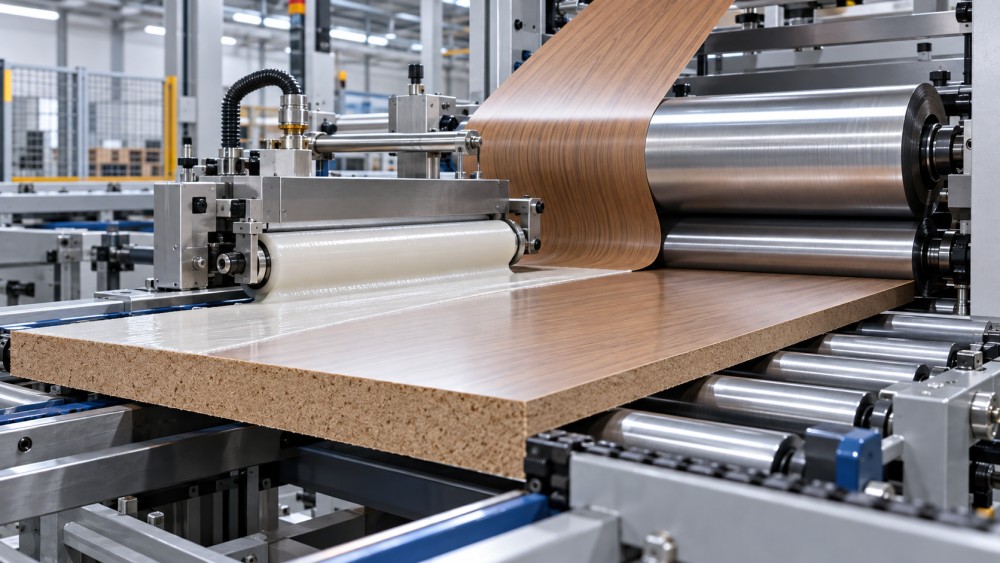
The nip’s job is to bring the coated substrate and covering into effective contact while the adhesive remains workable. Increasing force cannot correct an incompatible backing or an adhesive layer that has already cooled too far. Pressure is part of bond formation, but it is not a substitute for wetting or suitable surface preparation. [1, 2]
Check roller alignment, cleanliness, covering condition, and panel-thickness consistency before changing the pressure setting. A damaged or contaminated roller can create a repeat defect that resembles an adhesive problem. Uneven loading can leave one side acceptable while the other side lifts.
Be precise about what the machine displays. A pneumatic pressure reading is not automatically the pressure at the bonding interface. Cylinder geometry, roller arrangement, contact width, and covering deformation influence the applied load. Record the machine’s actual setting and units; do not convert it into a claimed bond-line pressure without an appropriate calculation or measurement.
Use the lowest validated loading that produces uniform contact and passes the specified bond assessment. During trials, inspect for film embossing changes, gloss marks, displaced adhesive, and board damage. Thin films and textured finishes may constrain the acceptable nip setting before the machine reaches its mechanical capacity.
Equipment geometry also matters. A profile-wrapping arrangement may use successive shaped rollers, whereas flat-panel lamination requires suitable contact across the panel width. When reviewing PUR panel lamination working specifications, distinguish the adhesive-system settings from the machine’s supported workpiece geometry, roller arrangement, and pressure controls. A wrapping-machine description should not be treated as proof of flat-panel capability without confirmation of its configuration.
Match line speed to application rate and open time
Line speed changes the time available between adhesive application and pressing. For a fixed distance, application-to-nip time equals that distance divided by line speed, using consistent units. Compare this time with the adhesive’s usable processing window under the actual board, film, coating, and ambient conditions. A published open time is only meaningful when its stated test conditions are understood.
Speed also interacts with adhesive delivery. If throughput rises while adhesive output remains unchanged, the coat weight may fall. Where the machine automatically synchronizes delivery with speed, verify that the control produces the intended coating rather than assuming synchronization guarantees it.
For steady application, the basic mass balance is:
Coat weight = adhesive mass flow ÷ coated area rate.
Use consistent units and the actual coated width. This relationship checks delivery, but it does not prove uniform distribution. Follow the equipment supplier’s safe sampling or measurement method to assess coating across the width; never reach into a moving nip.
A speed reduction can help some contact problems, yet it also increases travel time from application to nip and may change thermal exposure. Faster running shortens that travel time but can exceed the applicator’s delivery capacity or alter film handling. The correct adjustment depends on the observed failure, not a general rule that slower is always safer.
Build a trial that separates causes
Before the first trial, define acceptance criteria. These should cover appearance, coating consistency, bond assessment, and suitability for downstream handling. Use the adhesive supplier’s conditioning and test instructions where available, and distinguish an immediate handling check from a test after the specified cure period.
Keep the material combination fixed while establishing the initial settings. If temperature, speed, pressure, and adhesive quantity all change together, the resulting panel provides little diagnostic information.
Change one principal variable at a time during initial troubleshooting. After identifying a workable region, check combinations near the proposed operating limits. A single successful panel does not establish a robust production window. Include restart conditions and representative variation in board thickness or material temperature where these occur in normal production.
Read the failure surface before changing the recipe
A lifting film does not identify the cause by itself. Examine both exposed surfaces after a controlled bond assessment. Adhesive remaining predominantly on one side may indicate an interfacial adhesion problem, but the observation needs to be considered alongside curing time, surface preparation, and the test method. MDF fibers attached to the film suggest failure within the board surface rather than a clean separation at that interface; this alone does not prove that every performance requirement has been met. Failure-mode interpretation is covered in wood-bonding and adhesion references. [1, 2]
Use the defect pattern to prioritize checks:
- Edge lifting: inspect edge coating coverage, roller contact, contamination, and film tension.
- Blisters or isolated voids: investigate trapped air, contamination, substrate condition, and local contact.
- Repeating marks: compare the spacing with roller rotation and inspect roller surfaces.
- Failure after machining: review curing and handling time, tool condition, and the stress introduced at the edge.
These are investigation paths, not definitive diagnoses. Retain samples and record whether a defect begins at startup, follows a material change, or develops after a stop.
Release a controlled operating window
The production instruction should identify the approved material combination, permitted settings, actual-condition checks, stop-and-restart procedure, and response to out-of-limit results. Keep an approved sample and a record of the assessment method. Revalidate when the adhesive grade, film backing, MDF surface, or contact arrangement changes.
Safety instructions remain separate from the quality recipe. PUR products may involve isocyanate exposure hazards, while hot adhesive and moving rollers introduce thermal and mechanical hazards. Follow the specific safety data sheet, equipment guarding instructions, and site risk assessment. UK HSE guidance identifies isocyanates as a cause of occupational asthma; exposure controls must be based on the actual product and process. [3]
A usable specification tells an operator more than which numbers to enter. It defines which materials those numbers apply to, how to verify the process, and when to stop rather than compensate with extra heat or pressure.
Sources
[1] Alphonsus V. Pocius, Adhesion and Adhesives Technology: An Introduction, third edition, Hanser, 2012. Reference for wetting, surface preparation, adhesive behavior, and bond failure.
[2] USDA Forest Service, Forest Products Laboratory, Wood Handbook—Wood as an Engineering Material, FPL–GTR–282, 2021, particularly the chapters on moisture relations, wood adhesives, and wood-based composites.
[3] UK Health and Safety Executive, guidance on isocyanates and occupational asthma. Product-specific processing and protective measures must also follow the adhesive’s current technical and safety data sheets.
Have questions about this sector analysis, or seeking best practices specific to your niche? Drop us a line below and let the senior consultants at APIM assist you.
We respect your privacy. Your information is strictly confidential.
Related News
- 00
0000-00
NAPCOR Report: US PET Bottle Recycling Rate Fell to 29% in 2025 - 00
0000-00
How does washing affect contamination in post-consumer recycled PP resins? - 00
0000-00
How does feedstock affect depolymerization equipment selection? - 00
0000-00
US Sets 213.44% Preliminary Antidumping Deposit on Chinese PTMEG - 00
0000-00
When should epoxy be used as a thermal interface material for semiconductors?
Tag