




How to evaluate low VOC structural polyurethane systems for indoor bonding
How to Evaluate Low VOC Structural Polyurethane Systems for Indoor Bonding
Selecting low VOC structural polyurethane systems for indoor bonding looks straightforward on paper: review the emissions declaration, compare bond strength, and move on. In practice, that is rarely enough. Indoor assemblies are less forgiving because people notice odor quickly, enclosed spaces trap residual emissions, and bonded parts often see mixed stresses over time rather than a clean laboratory load case. A system that passes an initial screening can still create problems if it cures too slowly, reacts poorly with a primer, or loses adhesion after humidity cycling.
That is why technical evaluation teams usually need to look at these materials as a combination of chemistry, process behavior, and use environment. For applications in interior panels, insulation elements, electronics housings, composite subassemblies, furniture, appliances, or building-related components, the better question is not simply “Is this a low-emission polyurethane?” but “Will this system stay reliable and acceptable indoors across the full manufacturing and service window?”
Start with the actual bonding job, not the brochure claim
The first screening step should be application-specific. Structural polyurethane can mean very different things depending on whether the bond line is joining coated metal to plastic, mineral substrates to composite skins, or engineering plastics to films and seals. Low VOC structural polyurethane systems may be marketed under the same sustainability language, yet their cure profiles, flexibility, and surface tolerance can differ a lot.
A practical evaluation file should capture at least five basics: the substrates, the expected load type, the indoor exposure conditions, the assembly process, and any odor or emissions requirement from the customer or local market. Teams that skip this step often end up overvaluing one metric. For example, a very high lap shear result may look attractive, but if the joint is really dealing with peel, differential thermal expansion, or vibration, a tougher and slightly more flexible polyurethane may perform better in service.
This is where structured technical platforms such as APIM are useful in day-to-day evaluation work. In industrial adhesives, films, plastics, and composite applications, the material decision is rarely isolated. Bonding performance is tied to substrate formulation, surface treatment, processing history, and sometimes even upstream compounding consistency. A low VOC adhesive selected without that wider material context is only half evaluated.
VOC is important, but emissions data needs interpretation
Low VOC does not automatically mean low odor, and low odor does not always mean the full indoor emissions profile is acceptable. Those two points get confused all the time. Evaluation teams should ask how the supplier defines “low VOC,” what test method is being referenced, and whether the reported result reflects the adhesive as supplied, after cure, or in a representative bonded assembly.
Depending on the target market, teams may also need to check project-specific requirements for indoor air quality, automotive interior emissions, building product expectations, or customer internal protocols. There is no single universal threshold that settles every decision. The important thing is comparability: the same sample conditioning, the same cure state, and the same test basis across shortlisted systems.
A common mistake is comparing one supplier’s marketing statement with another supplier’s laboratory report and treating them as equivalent. They are not. If emissions performance is a gating issue, ask for the exact test conditions and whether additives, primers, or cleaners used in the line could change the final result.
Bond strength should be tested in the way the joint actually fails
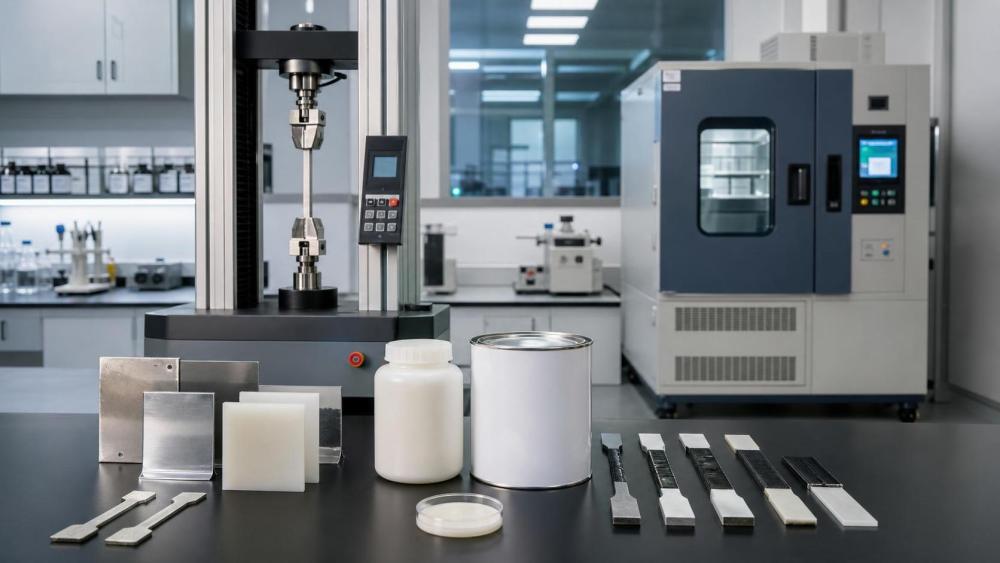
For indoor structural bonding, strength data matters, but the wrong strength data can mislead a team. Most evaluation packages start with lap shear because it is familiar and easy to compare. That is useful, just incomplete. Polyurethane systems are often chosen because they absorb stress better than more brittle chemistries, especially when substrates move differently under heat or load. So peel resistance, impact behavior, and fatigue response can be just as important as peak shear values.
It also helps to record where the failure occurs. Cohesive failure in the adhesive, adhesive failure at the substrate interface, and substrate tear-out tell very different stories. If a low VOC system shows decent initial strength but repeatedly fails at the interface on powder-coated metal or low-surface-energy plastic, the issue may be surface compatibility, not raw adhesive strength.
For technical teams working across advanced polymers, this is especially relevant. Engineering plastics such as PC, ABS, PA, PBT, PMMA, TPU, or modified filled compounds can react very differently to the same polyurethane formulation. Fillers, mold release residues, flame retardants, and recycled content may all affect adhesion. A general-purpose test coupon does not always reveal that.
Cure behavior can make or break the project
Many indoor bonding projects fail in production before they fail in service. The adhesive may have good final properties but still be a poor fit because open time is too short, viscosity drifts during dispensing, or fixture time does not match the line speed. Structural polyurethane systems can be one-component moisture-curing or two-component reactive systems, and the evaluation logic changes accordingly.
With one-component systems, moisture availability, bond-line geometry, and ambient conditions matter more than some teams expect. Thick sections may skin over quickly while curing more slowly inside. With two-component materials, mix ratio control, static mixer design, and pot life become immediate production variables. If the application sits in a factory with seasonal temperature swings, run trials under more than one ambient condition. A formulation that behaves well in a controlled lab can become inconsistent on the shop floor.
This is one area where process understanding matters as much as adhesive selection. APIM’s broader coverage of compounding, extrusion, films, and industrial materials reflects a real-world truth: material consistency upstream influences bonding consistency downstream. If bonded panels, housings, or composite parts arrive with variable surface energy or residual contamination, the adhesive system may be blamed for a processing problem it did not create.
Substrate preparation is often the hidden variable
When teams compare low VOC structural polyurethane systems, they sometimes treat surface preparation as fixed. It rarely is. Some systems are quite tolerant of minor variation; others need carefully controlled cleaning, abrasion, plasma treatment, or primer use. The trade-off is obvious: a highly forgiving adhesive may simplify production but not deliver the best ultimate performance, while a higher-performing system may demand more disciplined pretreatment than the current line can sustain.
If indoor appearance matters, look beyond adhesion and consider read-through, squeeze-out cleanup, staining risk on porous surfaces, and compatibility with decorative films or clear plastics. In electronics or interior assemblies, even a structurally sound bond can become unacceptable if the adhesive discolors nearby substrates or leaves a persistent odor after cure.
Durability testing should reflect indoor reality, not outdoor mythology
Indoor bonding is not “easy duty” by default. Interior applications may still face heat from electronics, cleaning chemicals, intermittent moisture, compressive load, creep, and repeated thermal cycling. Polyurethane is often selected because it balances strength with flexibility, but that balance should be verified against the real service profile.
Useful durability checks typically include temperature and humidity exposure, thermal cycling, creep under sustained load, and chemical compatibility with cleaners or nearby process fluids. If the product contains specialty films, coated sheets, or multilayer substrates, edge interaction and plasticizer migration may also need attention. Some failures show up only after aging, when a bond that initially looked excellent starts softening, embrittling, or losing adhesion at the interface.
Supply and documentation are part of technical risk
Technical teams sometimes leave supply questions until late, but with specialty polyurethane systems that can be risky. If a material depends on tight storage control, has limited shelf life, or comes from a narrow regional supply base, that affects qualification strategy. The same applies to document quality. A good supplier should be able to provide consistent technical data, processing guidance, safety information, and clarity on what has actually been tested.
For procurement and R&D teams working through a platform like APIM, this broader view matters. Material choice is not only about chemistry. It also includes batch stability, technical support quality, substitution risk, and how easily the adhesive can be discussed alongside the rest of the bill of materials, including films, plastics, reinforcements, and converted parts.
A practical shortlist method
If several candidates look similar, build the shortlist in stages. Remove any system that clearly misses the required emissions or odor threshold. Then compare process fit: cure speed, dispensing behavior, rework implications, and surface preparation burden. Only after that does it make sense to run deeper mechanical and aging work on the two or three most realistic options.
This staged approach saves time because it reflects how projects really succeed or fail. A slightly stronger adhesive that disrupts line efficiency or creates indoor odor complaints is often the wrong answer. On the other hand, a very low-emission system that bonds inconsistently across actual production substrates is not a safe indoor choice either.
In the end, evaluating low VOC structural polyurethane systems for indoor bonding is about balance. Emissions performance, odor control, mechanical reliability, cure behavior, substrate tolerance, and supply discipline all have to line up. Teams that compare those factors under realistic assembly conditions usually make better decisions than teams that rely on a single datasheet claim. If there is one place to be cautious, it is this: always test the adhesive on the real substrate set, with the real surface state, and under the real curing conditions expected in production. That is where the useful differences show up.
Have questions about this sector analysis, or seeking best practices specific to your niche? Drop us a line below and let the senior consultants at APIM assist you.
We respect your privacy. Your information is strictly confidential.
Related News
- 00
0000-00
Do polyolefin hot melt adhesives bond well to polyethylene? - 00
0000-00
Korean Study Finds PLA Barely Degrades in Landfill After 320 Days - 00
0000-00
How to assess batch consistency from a thermal potting compounds supplier - 00
0000-00
How much weight can carbon fiber reinforced plastics save in cars? - 00
0000-00
Switching from PS to ABS Sheet Extrusion: Equipment Checks