




How to Evaluate Two Component Structural Polyurethane Systems for Load-Bearing Bonds
How to Evaluate Two Component Structural Polyurethane Systems for Load-Bearing Bonds
Selecting the right two component structural polyurethane systems for load-bearing bonds starts with a basic correction: these materials should not be judged like general-purpose assembly adhesives. In a load-bearing joint, the adhesive is part of the structure. It has to carry stress, absorb movement, tolerate process variation, and stay reliable after heat, moisture, fatigue, and aging have done their work. That is why a data sheet alone rarely answers the real question. A technical evaluator is not only asking, “How strong is this adhesive?” but also, “Under what bond design, on which substrates, after what surface treatment, through which dispensing process, and under which service conditions does that strength still hold?”
That distinction matters because two component polyurethane systems sit in an interesting middle ground. They are often chosen when an epoxy is too rigid, a one-component adhesive is too slow or too process-sensitive, and a sealant-grade polyurethane does not deliver enough structural performance. In many industrial assemblies, especially where metals, composites, plastics, or coated substrates must be joined while still accommodating impact, vibration, or thermal expansion mismatch, a properly selected 2K structural PU can make engineering sense. But “properly selected” is doing a lot of work in that sentence.
What These Systems Actually Need to Be Evaluated For
A two component structural polyurethane system is formed when resin and hardener are mixed at a defined ratio and begin curing through a chemical reaction. That sounds straightforward. The complication is that the final bond performance depends on far more than chemistry family. Two products can both be sold as structural polyurethane adhesives and behave very differently in open time, green strength development, elongation, modulus, gap-filling ability, moisture sensitivity during processing, and durability on specific substrates.
For load-bearing use, the evaluation should revolve around five interacting questions:
- Can the cured adhesive sustain the required loads in the intended joint geometry?
- Will it develop handling strength and full cure within the production window?
- Does it bond reliably to the real substrate condition, not just the ideal substrate name?
- Will environmental exposure change failure mode or reduce safety margin too far?
- Can the material be dispensed, mixed, and controlled consistently in plant conditions?
Miss one of these, and the project can look qualified in the lab but fail in production or service.
Strength Numbers Need Context
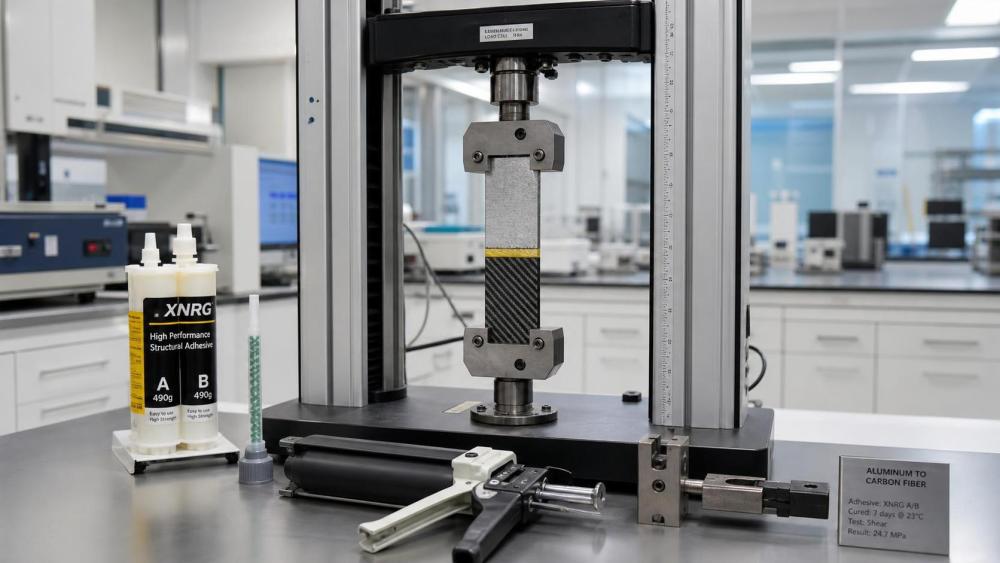
One of the most common mistakes is to compare only lap shear values. Shear strength is useful, but it is not a complete structural picture. Adhesive joints in service rarely see pure shear. They see peel, cleavage, torsion, impact, dynamic loading, and stress concentrations introduced by part geometry. A polyurethane that shows lower headline strength than a rigid epoxy may still be the better choice if the bonded assembly sees differential expansion, impact loading, or cyclic stress.
This is where modulus and elongation matter. A higher-modulus system can transfer load efficiently, but if it is too stiff for the bonded materials, it may drive edge stresses and crack initiation. A more flexible system can redistribute stress and survive movement better, but excessive flexibility may reduce positional stability or creep resistance under sustained load. Evaluators should read strength data together with elongation at break, Shore hardness where provided, and any information on tensile modulus or compression resistance. The right balance depends on joint design. Thin bond lines in rigid metal structures are assessed differently from thicker bond lines joining composites or polymer housings.
Failure mode also matters more than many teams expect. Cohesive failure within the adhesive, adhesive failure at the interface, and substrate failure do not mean the same thing. A substrate failure can look impressive, but it only proves something useful if the substrate condition and test setup represent reality. A bond that passes on grit-blasted coupons and fails on production-coated parts is not structurally qualified in any meaningful sense.
Substrate Compatibility Is Usually the Real Filter
In industrial bonding, “compatible with metal and plastic” is too vague to guide a decision. Technical evaluators need to separate substrate family from substrate condition. Aluminum is not one substrate; mill finish, anodized, conversion-coated, oily, laser-cut, and pre-painted aluminum can behave very differently. The same applies to engineering plastics. Polyamide, polycarbonate blends, glass-fiber reinforced compounds, thermoplastic polyurethanes, and low-surface-energy polyolefins do not present the same bonding surface, and moisture uptake or mold release residues can shift results significantly.
Two component structural polyurethane systems are often attractive because they can bond dissimilar materials while maintaining some toughness. Even so, they are not universal. Some plastics require primers or surface treatment. Some coated metals bond well only when the coating itself has sufficient cohesion and surface energy. In practice, the question is not whether the adhesive sticks to the nominal substrate, but whether the whole interface stack is stable: substrate, surface contamination, pretreatment, primer if used, adhesive, and service environment.
For that reason, any serious evaluation matrix should include production-representative surfaces and realistic contamination windows. Finger oils, coolant residue, oxidation, humidity exposure before bonding, and storage time after surface treatment can all move results. This is less glamorous than comparing brochure values, but it is where a large share of real bonding risk sits.
Cure Profile Is a Production Decision, Not Just a Chemistry Detail
A structural polyurethane may look excellent on final properties and still be a poor fit for the line. Two-component systems must be evaluated in terms of pot life, open time, fixture time, green strength development, and full cure profile. These are not interchangeable terms. A product can have adequate working time for dispensing but build handling strength too slowly for a fast takt assembly process. Another may cure quickly enough for throughput but create too narrow a process window for large-part positioning.
Temperature sensitivity is another practical issue. Mix ratio control, viscosity, and cure speed can all shift with shop-floor conditions. If the application involves large bond areas, vertical surfaces, or variable ambient conditions, rheology and sag resistance should be checked alongside cure timing. Technical teams sometimes discover late that the adhesive meets structural targets but requires process controls tighter than the operation can actually hold.
This is also why dispensing equipment cannot be treated as an afterthought. Two component polyurethane systems depend on accurate metering and effective mixing. A robust evaluation should include whether the selected formulation is compatible with available cartridge, meter-mix, or automated dispensing equipment, and how sensitive performance is to ratio deviation or mixing inconsistency. In plant terms, that affects scrap risk as much as bond strength does.
Environmental Resistance Is Where Many Comparisons Become Less Obvious
Polyurethane systems are frequently selected because they retain toughness under dynamic conditions, but long-term durability still has to be checked case by case. Heat, water, humidity, salt exposure, cleaning chemicals, fuels, plasticizers, and UV can all change bond behavior. The relevant question is not whether the adhesive is “resistant” in a generic sense. It is whether it maintains enough retained performance after the exposures that matter for the target assembly.
For load-bearing joints, retention after aging often matters more than the initial room-temperature result. Some systems show attractive early strength but lose too much stiffness or interface stability under hot-wet conditions. Others remain durable in moisture but are less suitable for prolonged high-temperature service. If the assembly will operate in transportation, construction, electronics enclosures, composite panels, or industrial equipment, the qualification plan should reflect the actual stress and exposure profile rather than relying on a single accelerated test.
Evaluators should also watch for creep behavior. Polyurethane’s flexibility is often an advantage, but under sustained static load, particularly at elevated temperature, creep can become a design concern. Where joints carry continuous structural load, long-term displacement or load retention needs attention in the test program.
What to Compare During Selection
Common Misreadings During Technical Review
A few errors come up repeatedly in adhesive selection work. One is assuming that “structural” means the same thing across suppliers. It does not. The label is useful commercially, but the practical meaning comes from tested performance and use conditions. Another is treating cure speed as an absolute advantage. Faster is only better if it still allows correct wet-out, positioning, and mixing quality. A third is assuming flexibility automatically improves durability. In some assemblies it does; in others it increases creep or weakens dimensional control.
There is also a procurement-side mistake that deserves attention: comparing cost per kilogram without converting that into applied cost and qualified performance. Density, bond-line thickness, scrap from short pot life, primer requirements, dispensing complexity, and rework rates can all shift the real economics. For load-bearing bonds, the cheapest material on paper may be the most expensive option once failure risk and production loss are included.
A Better Way to Make the Decision
The most effective evaluation path is usually staged. Start with a narrow technical screen: substrate compatibility, target cure window, basic mechanical fit, and any obvious environmental exclusions. Then move into application-representative testing using real surfaces, realistic bond geometry, and processing conditions close to production. Only after that should the team compare implementation details such as equipment fit, packaging format, shelf life, documentation, and supplier responsiveness.
That approach keeps the discussion grounded. Two component structural polyurethane systems can be excellent solutions for load-bearing bonds, especially where dissimilar materials, movement tolerance, and impact resistance matter. But they are rarely “plug-and-play structural.” The right evaluation treats them as part material, part process, and part joint design decision. Teams that make that shift usually reach better choices faster, because they stop asking which adhesive looks strongest on paper and start asking which system remains dependable in the assembly they are actually building.
Have questions about this sector analysis, or seeking best practices specific to your niche? Drop us a line below and let the senior consultants at APIM assist you.
We respect your privacy. Your information is strictly confidential.
Related News
- 00
0000-00
How does washing affect contamination in post-consumer recycled PP resins? - 00
0000-00
How does feedstock affect depolymerization equipment selection? - 00
0000-00
US Sets 213.44% Preliminary Antidumping Deposit on Chinese PTMEG - 00
0000-00
When should epoxy be used as a thermal interface material for semiconductors? - 00
0000-00
US Midterm Results Unlikely to Quickly Shift Recycled Plastics Market or Legislation