




How Should Aluminum Be Prepared Before Applying PU Structural Adhesive?
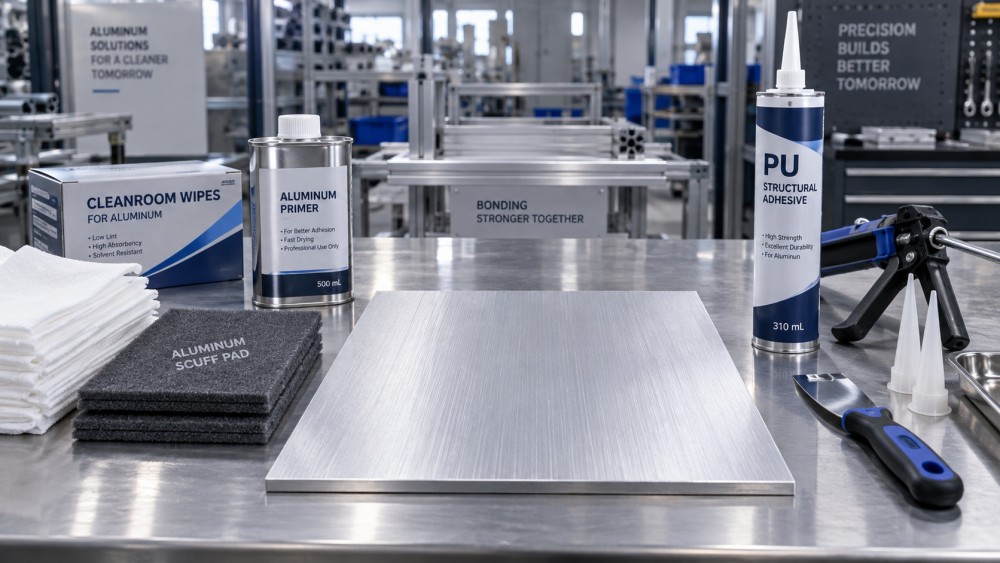
Aluminum should be clean, dry, and free from weak surface layers before a polyurethane (PU) structural adhesive is applied. A practical starting sequence is degreasing, controlled abrasion where appropriate, removal of abrasion debris, and application of an adhesive-compatible pretreatment or primer when the bond specification requires it. The adhesive manufacturer’s instructions take precedence over a generic preparation method.
The important distinction is between achieving initial adhesion and maintaining adhesion in service. A cleaned and abraded surface may provide adequate initial strength, yet prove insufficient under humidity, salt exposure, temperature cycling, or sustained loading. Preparation must therefore be selected for the aluminum finish, the particular PU formulation, and the joint’s operating environment—not simply for how clean the metal looks.
Why does aluminum need preparation if it already looks clean?
Aluminum naturally develops an oxide film when exposed to air. Adhesive bonding takes place at this surface rather than against permanently bare metal. A sound, controlled oxide surface can support bonding; loose corrosion products, contaminated oxide, and poorly attached surface layers cannot provide a reliable foundation.
Visible cleanliness also says little about thin films of rolling oil, machining fluid, fingerprint residue, silicone, or protective-film adhesive. These contaminants can prevent the PU adhesive from wetting the surface properly. A joint may appear fully filled while containing areas where the adhesive has made inadequate contact with the substrate.
The objective is not to remove every trace of oxide and preserve bare aluminum indefinitely. That is impractical because oxide reforms quickly. The objective is to create a clean, stable, reproducible bonding surface and, where necessary, protect or chemically modify that surface using a qualified treatment.
What is a practical preparation sequence for untreated aluminum?
For uncoated aluminum, the following sequence is a useful starting point for process development. It is not a substitute for qualification with the selected adhesive and actual production material.
- Identify the incoming surface. Confirm the alloy, finish, protective film, and any previous chemical treatment. Inspect for corrosion, heavy oil, machining residues, and storage damage.
- Remove contamination before abrasion. Use an approved solvent-cleaning or aqueous-cleaning process. Abrading an oily surface can spread contamination or work it into the surface.
- Apply controlled abrasion if specified. Use a suitable abrasive and consistent technique to remove weak surface material and produce an even finish without excessive metal removal.
- Remove dust and residual contamination. Use approved vacuuming, wiping, or washing methods. Any compressed air used must be clean, dry, and oil-free.
- Dry and apply the specified treatment. Ensure that cleaning liquid has evaporated or rinse water has been removed before applying an approved pretreatment, primer, or adhesive.
- Bond within the validated preparation window. Keep the prepared area protected from handling, dust, condensation, and process fumes.
Some qualified processes use chemical pretreatment instead of mechanical abrasion. Others permit bonding to a specified factory finish without abrasion. Adding an extra sanding or solvent step to an approved process is not automatically an improvement; it can damage the intended bonding surface.
Which cleaning method should be used?
The cleaner must remove the actual contaminant without leaving a film or damaging the substrate finish. Isopropyl alcohol and acetone are examples of solvents used in some bonding procedures, but neither is a universal answer. Their suitability depends on the oil or residue present, solvent purity, any coating on the aluminum, and the adhesive supplier’s requirements.
For an approved solvent-wiping process, a two-cloth method can reduce redeposition: one clean, lint-free cloth wets and loosens the contamination, while a second removes the contaminated liquid before it dries. Change cloths frequently rather than moving dissolved oil across the entire bonding area. Avoid dipping a used cloth into clean solvent.
Heavy machining oils or complex coolant residues may require a controlled aqueous process rather than a quick solvent wipe. Cleaner concentration, temperature, contact time, rinsing, and drying all need control. Aluminum can be attacked by unsuitable cleaning chemistry, and incomplete rinsing can leave residues that interfere with adhesion.
Household detergents, fragranced cleaners, and unspecified degreasers are poor substitutes for a documented industrial cleaning process. Follow the cleaner’s safety data sheet, provide appropriate ventilation, and keep solvent handling separate from ignition sources.
How much abrasion is needed?
Abrasion should produce a consistent, sound surface—not the roughest surface possible. Excessive roughness can retain dust, make cleaning difficult, or create features the adhesive does not fully wet. Aggressive abrasion can also damage thin sheet or alter the fit of a closely controlled joint.
There is no single abrasive grit suitable for every PU structural adhesive and aluminum finish. The process should specify abrasive type, grade, tool or manual method, and replacement criteria. A supplier’s recommended grit range is a starting condition to validate, not a guarantee of durability.
Use dedicated abrasives suitable for aluminum. Tools previously used on steel can introduce foreign particles and corrosion risks. Abrasive blasting requires similar control over media cleanliness, pressure, and resulting profile. It should not be introduced solely because it creates a visibly rougher surface.
For a repeatable process, describe the required result as well as the operation. An instruction such as “sand lightly” leaves too much variation. The acceptable finish, areas to be treated, debris-removal method, and inspection criteria should be defined.
Can anodized, painted, or powder-coated aluminum be bonded directly?
Yes, but the adhesive then bonds to the treated or coated surface, whose properties become part of the joint. The preparation route for bare aluminum should not be applied automatically.
A strong adhesive cannot compensate for a coating that separates from the aluminum. If testing shows coating detachment, the corrective action may involve changing the coating or creating a controlled bare-metal bonding area. Simply choosing a stronger adhesive can leave the same weak interface in place.
When is a primer or chemical pretreatment necessary?
A primer or pretreatment becomes especially relevant when the joint must resist moisture, corrosion, thermal cycling, or demanding long-term loads. These treatments can promote adhesion and improve interface stability, but their functions and application requirements differ.
A conversion treatment modifies the aluminum surface. An adhesive primer creates a compatible interfacial layer. Certain systems use both; others use neither. Products should not be combined merely because each is described as an adhesion promoter.
The primer must be approved for the selected PU adhesive and substrate finish. Application quantity, coverage, drying conditions, and minimum and maximum overcoating times matter. Excessive primer can create a weak layer, while premature adhesive application can trap solvent. Exceeding the permitted bonding window may require reprocessing.
Do not assume that a primer intended for a polyurethane sealant is suitable for a structural polyurethane adhesive. Likewise, “primerless” describes performance under specified conditions, not permission to bond contaminated aluminum. Chemical pretreatments also require appropriate handling and waste controls.
How dry must the aluminum be before PU adhesive application?
The surface should be free of condensation, standing water, and residual cleaning liquid. Aluminum moved from a cold storage area into a warm, humid workspace can collect condensation even when it initially appears dry. Surface temperature and the local dew point are therefore relevant process variables.
Moisture requirements depend on the adhesive chemistry. One-component moisture-curing PU adhesives need access to moisture for cure, but this does not justify wetting the aluminum unless the supplier explicitly specifies that procedure. Excess water can react with isocyanate groups and generate carbon dioxide, potentially producing bubbles or foam.
Two-component PU adhesives also require control of unintended moisture. Their cure is driven by mixing the specified components, and water contamination can disrupt the intended reaction or bond quality. The practical distinction is between controlled cure conditions and uncontrolled water at the interface.
How long can prepared aluminum wait before bonding?
There is no universal safe waiting time. The acceptable interval depends on the preparation method, ambient conditions, handling, primer requirements, and storage protection. A surface left exposed beside machining or spraying operations faces different contamination risks from one held in a controlled bonding area.
Bond promptly within the adhesive supplier’s instructions and the validated process window. Record preparation and primer application times where timing affects acceptance. If production delays exceed the allowed interval, use a defined reprocessing procedure rather than assuming another solvent wipe restores the surface.
Prepared areas should not be touched with bare hands. Clean gloves help, but gloves contaminated by lubricants or other operations can still transfer residue. Temporary coverings must also be qualified: protective tapes or films can leave adhesive residue and undo the preparation work.
How can preparation quality be checked?
Visual inspection can detect corrosion, debris, incomplete abrasion, and obvious contamination, but cannot establish bond durability. A water-break test can help identify some hydrophobic contamination on suitable unprimed surfaces: clean areas support a more continuous water film, while contaminated areas may cause beading or breaks. It is a screening tool, not proof of adhesive compatibility, and the part must be properly dried afterward.
Qualification should use the intended aluminum finish, PU adhesive, bondline thickness, and cure conditions. Initial strength testing establishes a baseline. Testing after service-relevant humidity, water, salt, or temperature exposure helps reveal interface deterioration that a freshly cured joint may conceal.
Failure location provides essential information. Separation at the aluminum interface, failure within the adhesive, and coating detachment point to different limitations. Cohesive failure within the adhesive can be encouraging, but it is not an automatic pass: the measured strength and retained performance must still satisfy the joint requirements.
Production records should connect the result to the process: surface finish, cleaner, abrasive, treatment or primer batch, preparation time, environmental conditions, adhesive batch, and cure history. Changes to incoming oil, anodizing, protective film, or coating should trigger review even if the aluminum alloy remains unchanged.
Is degreasing and sanding enough?
It can be enough for a qualified adhesive–substrate combination in a defined service environment. It should not be assumed sufficient for every structural joint. The decisive evidence is acceptable performance after representative aging, using a preparation method that production can reproduce.
When specifying what surface preparation is needed before applying structural adhesives on aluminum, request instructions for the exact PU product and finish—not merely an “aluminum-compatible” claim. A useful specification identifies permitted cleaners, abrasion or pretreatment requirements, primer conditions, bonding windows, and acceptance tests. That converts a general recommendation into a controllable manufacturing process.
Have questions about this sector analysis, or seeking best practices specific to your niche? Drop us a line below and let the senior consultants at APIM assist you.
We respect your privacy. Your information is strictly confidential.
Related News
- 00
0000-00
How does washing affect contamination in post-consumer recycled PP resins? - 00
0000-00
How does feedstock affect depolymerization equipment selection? - 00
0000-00
US Sets 213.44% Preliminary Antidumping Deposit on Chinese PTMEG - 00
0000-00
When should epoxy be used as a thermal interface material for semiconductors? - 00
0000-00
US Midterm Results Unlikely to Quickly Shift Recycled Plastics Market or Legislation