




How Does Moisture Affect PU Hot Melt Adhesives on Porous Substrates?
How Does Moisture Affect PU Hot Melt Adhesives on Porous Substrates?
Moisture can help reactive polyurethane (PU) hot melt adhesives cure, yet excess water in wood, paper, textiles, or other porous substrates can undermine bond quality. So, how does moisture affect hot melt adhesive performance on porous substrates? The answer depends on substrate moisture content, ambient humidity, adhesive chemistry, and processing conditions. Too little moisture can slow curing, while excess moisture may cause foaming, interfacial defects, or inconsistent strength.
The practical challenge is not simply keeping materials dry. It is maintaining a controlled moisture condition that allows the adhesive to wet the substrate, develop handling strength, and complete its chemical cure without introducing defects. A joint that looks sound when it leaves the press may still be vulnerable during storage, machining, or service.
Initial setting and moisture curing are different events
The distinction matters because “PU hot melt” can describe different products. Moisture-reactive polyurethane hot melts, often called PUR hot melts, contain reactive groups that undergo chemical curing after application. Nonreactive thermoplastic polyurethane hot melts solidify mainly through cooling and do not rely on the same moisture-curing mechanism. Confirm the chemistry before diagnosing a moisture problem.
A reactive PUR adhesive develops initial strength as the molten material cools. This physical setting stage helps hold an assembly together. Moisture from the substrate and surrounding air then participates in reactions involving isocyanate groups, building the cured polymer structure. Chemical curing develops the adhesive’s ultimate performance, including its resistance to heat and sustained loading.
Consequently, adequate green strength does not prove that the joint is fully cured. Dry substrates, low humidity, thick bondlines, and moisture-resistant facing materials can delay cure within the assembly. A surface that feels set may hide a less-cured interior. Handling time and final-performance release time should therefore be validated separately rather than treated as one production milestone.
Why porous substrates complicate moisture control
Porosity and moisture absorption are related, but they are not interchangeable. Wood and paper are hygroscopic: their moisture content changes with the surrounding environment. A synthetic nonwoven may have an open structure yet absorb little water into its fibers. Surface treatments, sizing agents, coatings, and fiber blends further change how moisture and adhesive move through a material.
Porous materials also create competing demands during application. Some penetration can support mechanical anchoring, but excessive penetration can leave too little adhesive at the interface. Melt viscosity, substrate temperature, coat weight, assembly pressure, and pore structure all influence this balance. Increasing adhesive temperature to improve flow may worsen penetration rather than solve poor bonding.
Consider a wood-based panel bonded to a relatively impermeable decorative film. The panel may supply moisture for curing, while the film restricts moisture entry from the opposite side. That assembly behaves differently from two breathable fabrics bonded with a discontinuous adhesive pattern. A cure schedule established for one construction should not automatically be transferred to the other.
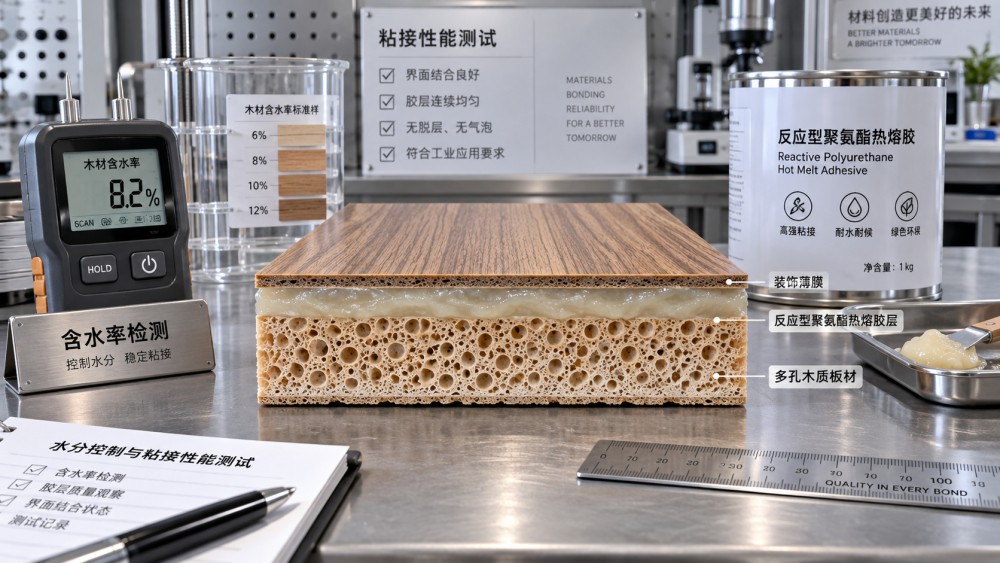
The useful picture is a cross-section of the complete joint: where water is stored, how it reaches the adhesive, where gas can escape, and whether enough adhesive remains between the surfaces. Room humidity alone cannot describe that system.
Too little moisture delays cure; too much can damage the joint
Low available moisture usually makes chemical curing slower. The assembly may still have enough initial strength for gentle handling, but it can remain more vulnerable to creep, heat, or further processing before cure is complete. This becomes especially relevant when production materials are oven-dried, stored in a dry environment, or enclosed between low-permeability layers.
Adding water is not a general remedy. In reactive PUR chemistry, the reaction between isocyanate groups and water produces carbon dioxide as part of the curing pathway. Under suitable conditions, gas can dissipate without creating significant defects. Excess moisture, rapid local reaction, or restricted gas escape can instead produce bubbles and voids. Hot adhesive contacting wet material may also generate water vapor.
Visible foaming is a warning, but the absence of visible bubbles does not establish bond quality. Smaller internal voids can reduce effective bonded area. Surface water may interfere with intimate adhesive contact, while moisture-driven swelling and later drying can stress the interface. A damp wood panel can therefore produce problems during bonding and additional problems after its dimensions change.
Excess moisture can also accelerate local reaction before wetting and assembly are complete. The extent depends on the formulation and process. Spraying water onto a substrate should only be considered when the adhesive supplier supports a defined, validated procedure—not as an improvised response to slow curing.
Measure the material, not just the room
There is no universal moisture-content limit for all porous substrates and PUR adhesives. A suitable range depends on the material, adhesive grade, bond geometry, and intended service conditions. Supplier guidance is a starting point, but the production window must be checked using the actual assembly.
Ambient relative humidity indicates the surrounding conditions; it does not directly measure substrate moisture. Thick boards, tightly wrapped rolls, and stacked sheets may equilibrate slowly. Material arriving from a cold warehouse can also develop condensation if its surface temperature is below the production area’s dew point, even when its bulk moisture content appears acceptable.
A practical inspection plan should capture:
- Substrate moisture at representative locations, including differences between exposed surfaces and internal material where relevant.
- Measurement method, calibration, and moisture-content reporting basis, so results from different suppliers are comparable.
- Substrate temperature, room temperature, and relative humidity at bonding and during post-bond storage.
- Time between conditioning, unpacking, measurement, and adhesive application.
Handheld moisture meters are useful for screening, but their readings can depend on species, density, temperature, and instrument settings. They should not be assumed to work equally well on wood, coated paper, textiles, and composite panels. Where acceptance decisions are critical, verify the chosen method against an appropriate reference procedure for that substrate.
Build a process window around the real assembly
A meaningful trial varies moisture together with the factors that influence wetting and curing. Testing only at comfortable laboratory conditions can miss the production extremes that cause rejected parts. Use representative substrate lots and include the dry and humid conditions reasonably expected in manufacturing, storage, and transport.
Evaluate application temperature, adhesive quantity, open time, pressure, and bondline thickness within the supplier’s recommended operating limits. Excess pressure can squeeze adhesive away from the interface or drive it into pores. Insufficient pressure can leave incomplete contact. A thicker bondline may provide coverage on a rough surface but increase the distance moisture must travel during curing.
Test strength at several relevant stages: after initial setting, before the next manufacturing operation, after the validated cure period, and after service-related conditioning. Peel, shear, heat exposure, or humidity cycling should reflect how the joint will actually be loaded. A room-temperature strength test alone may not reveal creep under sustained load or dimensional stresses caused by moisture changes.
Inspect the failure surface as carefully as the measured force. Adhesive remaining mainly on one side suggests an interfacial problem, although contamination or insufficient wetting may be responsible rather than moisture alone. Voids point toward gas generation or entrapped air. Fiber tear shows that failure occurred within the substrate under those test conditions; it does not automatically prove durability in a different environment.
Keep moisture out of the adhesive delivery system
Moisture is needed at the bonded assembly, not inside the storage container or melter. Premature exposure can cause skinning, gel formation, viscosity changes, or equipment blockage. Follow the supplier’s packaging, opening, resealing, and equipment-handling instructions. Use moisture-protected delivery equipment and any dry-gas provisions specified for the system.
Do not confuse that requirement with making the production room extremely dry. Protecting uncured adhesive in the delivery system and providing suitable conditions for joint curing are separate controls. Also follow the safety data sheet, including ventilation and exposure-control requirements for reactive polyurethane processing.
Choose the adhesive around moisture variability, not nominal strength alone
Reactive PUR hot melts can be useful where rapid initial handling and durable cured performance are both required. Their value depends on whether the manufacturer can control incoming material condition and allow sufficient post-bond curing. If moisture variation is unavoidable, selection trials should emphasize robustness across that variation rather than the highest strength achieved under one favorable condition.
Conventional thermoplastic hot melts avoid moisture-dependent chemical curing, but moisture can still affect their wetting, interfacial contact, and substrate stability. Their heat resistance and creep behavior also need application-specific evaluation. Switching chemistry removes one mechanism; it does not remove the need for moisture management.
For procurement and engineering teams, the useful supplier discussion concerns evidence: the recommended substrate condition, validated application range, cure requirements for the proposed construction, and performance after relevant environmental exposure. Generic claims of “water resistance” cannot answer whether a damp porous substrate can be bonded reliably.
Global Advanced Polymers & Industrial Materials Intelligence Network (APIM) connects adhesive chemistry with substrate behavior, processing requirements, and material-selection decisions. That combined perspective matters here: a bonding problem may originate in the adhesive, but it may also begin with panel storage, film permeability, fiber treatment, or downstream handling.
Before approving a PUR bonding process, establish a measurable substrate-moisture window and a release criterion that distinguishes handling strength from completed cure. Then verify both under realistic production conditions. The objective is not the driest substrate or the fastest reaction—it is a repeatable joint with enough wetting, controlled curing, and demonstrated durability.
Have questions about this sector analysis, or seeking best practices specific to your niche? Drop us a line below and let the senior consultants at APIM assist you.
We respect your privacy. Your information is strictly confidential.
Related News
- 00
0000-00
Do polyolefin hot melt adhesives bond well to polyethylene? - 00
0000-00
Korean Study Finds PLA Barely Degrades in Landfill After 320 Days - 00
0000-00
How to assess batch consistency from a thermal potting compounds supplier - 00
0000-00
How much weight can carbon fiber reinforced plastics save in cars? - 00
0000-00
Switching from PS to ABS Sheet Extrusion: Equipment Checks