




ECHA Adds Two PU Adhesive Curing Agents to SVHC List
On July 12, 2026, the European Chemicals Agency (ECHA) added two aromatic amine curing agents commonly used in polyurethane structural adhesives to the SVHC Candidate List: an m-Phenylenediamine derivative and a 4,4'-Methylene dianiline analog. For companies shipping PU Structural Adhesives & Foams into the EU, this is not just a regulatory update; it directly affects product compliance routes, supply chain information flow, and the pace of formulation review. Exporters, overseas distributors, and downstream users in automotive and building materials should pay close attention because the change ties regulatory status to concrete disclosure and SCIP-related obligations from January 2027 when the substances are present at or above 0.1%.
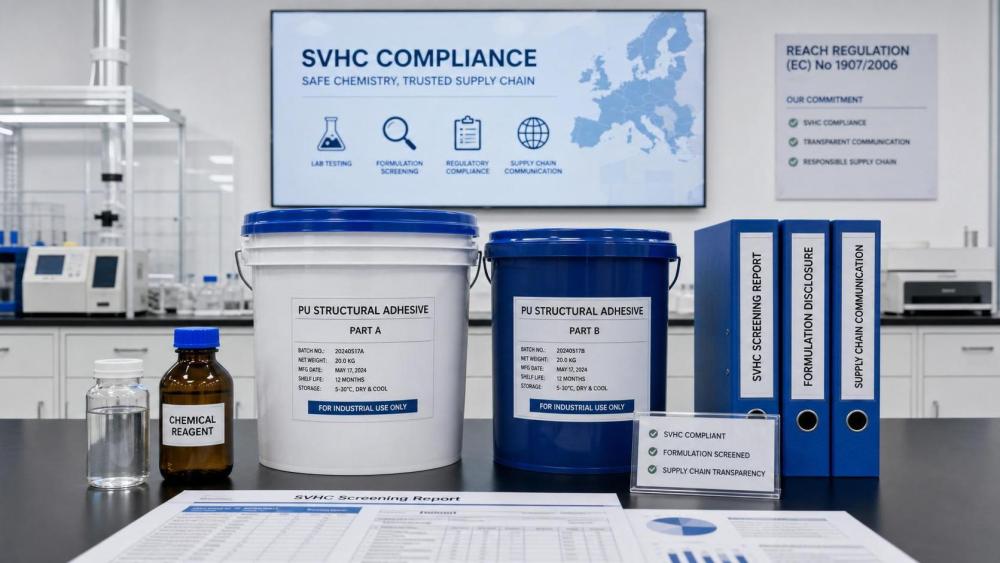
What Has Been Confirmed So Far
According to the information provided, ECHA expanded the SVHC Candidate List on July 12, 2026 by including two new curing agents used in PU structural adhesive systems. The substances identified in the input are an m-Phenylenediamine derivative and a 4,4'-Methylene dianiline analog.
The confirmed compliance implication is that, from January 2027, mixtures containing either substance at a concentration of 0.1% or above will require SCIP notification and supply chain information communication. The information provided also states that this change will directly affect the compliance pathway for PU Structural Adhesives & Foams exported to the EU.
Where the Pressure Will Appear First
Export-facing product portfolios will come under immediate review
Direct trading companies and manufacturers serving the EU market may be affected first because the regulatory trigger is tied to whether the relevant substances are present in exported mixtures at or above the stated threshold. The main impact is likely to appear in product screening, compliance documentation, and shipment readiness for PU Structural Adhesives & Foams destined for EU customers.
Distribution channels will need stronger substance visibility
Overseas distributors are specifically identified in the provided information as parties that need to act quickly. From an industry perspective, their exposure lies in the handoff of product information across the sales chain. What deserves closer attention is whether product dossiers, substance declarations, and downstream communication can support SCIP-related requirements and customer questions without delay.
Automotive and building materials users may face validation decisions
The input also highlights automotive and building materials end customers. Analysis shows their concern is less about the listing itself and more about what it means for approved materials, qualification timing, and substitution planning. Where PU structural adhesives or foams are already embedded in procurement or application workflows, formulation assessment and alternative verification may become an immediate operational issue.
Supply chain service roles will be pulled into documentation flow
Observably, the impact is not limited to manufacturers alone. Service providers involved in compliance support, documentation handling, and cross-border product movement may also be affected because the change increases the need for consistent material information transfer. The business pressure point is not only the substance status, but whether supporting records can move through the supply chain accurately and on time.
What Companies Should Watch Now
Check which formulations are actually within scope
The first practical issue is to identify whether exported PU Structural Adhesives & Foams contain either listed substance and, if so, whether the concentration reaches or exceeds 0.1%. This is the point where a regulatory update becomes a product-level compliance issue.
Separate listing news from implementation work
Analysis shows companies should distinguish between the fact of SVHC Candidate List inclusion and the operational work that follows from January 2027. The listing is already confirmed in the provided information, but the business task is to translate that into SCIP notification readiness and reliable supply chain communication for affected mixtures.
Prepare supplier and customer communication early
What deserves closer attention is the quality of upstream and downstream information exchange. Manufacturers, distributors, and procurement teams may need to confirm substance presence, align documentation language, and prepare for customer requests tied to EU compliance expectations. Delayed communication can create avoidable friction even before formal filing deadlines arrive.
Start substitution and validation reviews without assuming a final outcome
The provided information states that overseas distributors and automotive and building materials end customers need to begin formulation assessment and alternative validation immediately. Observably, this does not by itself confirm which substitutes will be used or how quickly transitions will occur. It does indicate that companies should begin technical and commercial review now rather than wait for customer-side pressure to surface later.
Why This Looks Like More Than a Routine Update
Analysis shows this development is best read as a near-term compliance trigger with longer-term signaling value. In the short term, the effect is concrete: affected PU Structural Adhesives & Foams entering the EU will face SCIP and supply chain disclosure requirements from January 2027 if the concentration threshold is met. In the broader industry context, the update also signals that curing agent selection in PU systems is becoming a more visible compliance variable for export-oriented business.
At the same time, it is more appropriate to understand this as an industry dynamic that still requires continued observation rather than a fully settled commercial outcome. The confirmed facts establish regulatory direction and immediate review needs, but they do not by themselves determine how widely formulations will change, how quickly substitutes will be validated, or how each downstream segment will respond.
How the Market May Need to Read This
From an industry perspective, the significance of this update lies in its direct connection between SVHC status and day-to-day product compliance for EU-bound PU Structural Adhesives & Foams. The immediate issue is not abstract policy change, but whether companies can identify affected formulations, support SCIP-related obligations, and maintain clear information transfer across suppliers, distributors, and end users.
A balanced reading is that this is already a real compliance development, but its wider commercial consequences are still unfolding. It is more appropriate to understand the news as a concrete short-term requirement combined with a longer-term signal that formulation transparency and substitution readiness will matter more in this product category.
Basis of This Article and What Still Needs Verification
This article is based on the user-provided news title, event date, and event summary. For this type of industry update, commonly relevant source categories may include official notices, company disclosures, industry association updates, authoritative media reporting, and standards-related documents.
No specific official source link was provided in the input, so the exact official reference still needs ongoing verification. Observably, the next areas to monitor are any further official wording related to the listed substances, the practical interpretation of SCIP-related requirements for affected mixtures, and how supply chain communication expectations are implemented in actual EU-facing business operations.
Have questions about this sector analysis, or seeking best practices specific to your niche? Drop us a line below and let the senior consultants at APIM assist you.
We respect your privacy. Your information is strictly confidential.
Related News
- 00
0000-00
NAPCOR Report: US PET Bottle Recycling Rate Fell to 29% in 2025 - 00
0000-00
How does washing affect contamination in post-consumer recycled PP resins? - 00
0000-00
How does feedstock affect depolymerization equipment selection? - 00
0000-00
US Sets 213.44% Preliminary Antidumping Deposit on Chinese PTMEG - 00
0000-00
When should epoxy be used as a thermal interface material for semiconductors?